
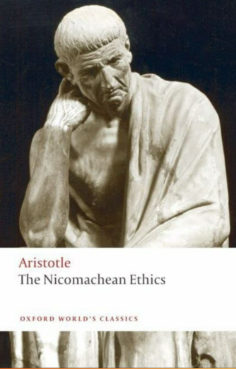
Auteur : ARISTOTLE
Editeur : Oxford University Press
Genre : PHILOSOPHIE, PSYCHOLOGIE, RELIGION
Année d'édition : 2009
Nombre de page : 277
Cote : B 430 .A5 R67 2009
Résumé : “The Nicomachean Ethics” is a seminal work by Aristotle, the ancient Greek philosopher. Composed in the 4th century BC, this book offers a comprehensive exploration of ethics, focusing on the concept of eudaemonia, or ‘flourishing’, as the ultimate goal of human life. In “The Nicomachean Ethics,” Aristotle presents his theory of virtue ethics, arguing that moral virtue is a state of character that lies between deficiency and excess. He posits that by cultivating virtues and practicing moderation, individuals can achieve eudaemonia. One notable quote from the book is: “Virtue, then, is a state that decides, consisting in a mean, the mean relative to us, which is defined by reference to reason, that is to say, to the reason by reference to which the prudent person would define it.” This quote encapsulates Aristotle’s doctrine of the mean, highlighting the role of reason and prudence in virtuous behavior. Another insightful quote is: “Happiness, then, is something final and self-sufficient, and is the end of action.” Here, Aristotle underscores the significance of eudaimonia as the ultimate end and purpose of human life. Throughout “The Nicomachean Ethics,” Aristotle explores various aspects of moral and intellectual virtues, providing a detailed analysis of their nature, cultivation, and role in human flourishing. He discusses topics such as courage, temperance, justice, wisdom, and friendship, offering insights into their relevance for personal and social well-being. Aristotle also delves into broader philosophical issues, such as the nature of the soul, the role of reason in human life, and the relationship between virtue and happiness. He provides a nuanced critique of hedonism and utilitarianism, defending a conception of happiness that involves not only pleasure and utility but also moral and intellectual excellence. In the later sections, Aristotle reflects on the role of education, law, and politics in promoting virtue and eudaemonia. He argues that ethical character is shaped by habituation and learning, underscoring the importance of moral education and a just political order. In conclusion, “The Nicomachean Ethics” by Aristotle offers a profound exploration of ethics and human flourishing. Its blend of philosophical analysis, moral insight, and practical wisdom make it a foundational text in Western philosophy. The book serves as a testament to Aristotle’s deep understanding of human nature and the good life, providing readers with a richer appreciation of the complexities and possibilities of ethics.
Disponibilité :

